The Blackjack Myth That Counting Cards Changes the Cards
Blackjack card counting estimates which cards may remain; learn what it can tell you, what it cannot control, and how to read the table more clearly.
The most common blackjack card-counting mistake is to imagine that a running count makes the next card obey the player. It does not. Blackjack card counting is an attempt to estimate which cards may remain after earlier cards have been dealt, and confusing that estimate with control can lead to poor decisions and misplaced confidence.
The distinction is simple, but table talk often blurs it. A count is a record of observed cards, interpreted under a particular counting system. The deck or shoe still produces the next card according to the cards actually left in it, not according to anyone’s hopes, notes or arithmetic.
Blackjack card counting tracks what has already appeared
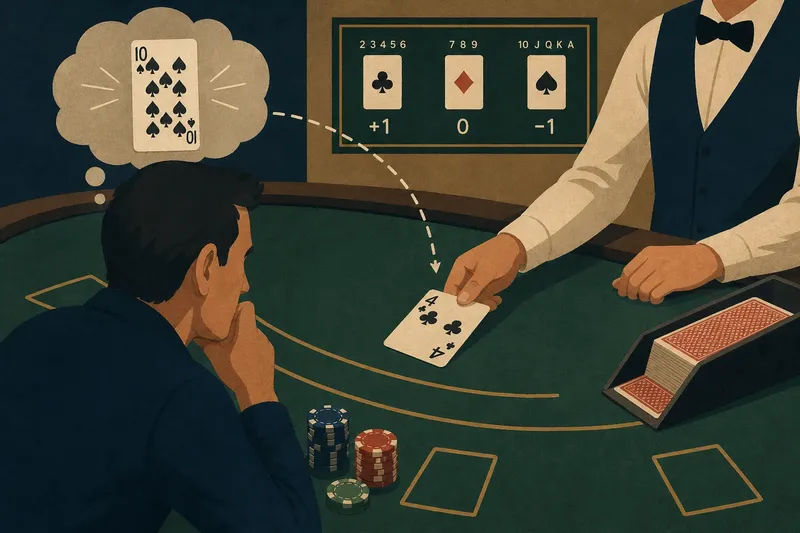
In a common high-low counting system, a player assigns a small value to each card as it appears. Low cards count as plus one, middle cards as zero, and high cards as minus one. The player keeps a running total, then may adjust it for how many decks are thought to remain in the shoe.
The purpose is not to identify the next card. It is to form a rough picture of the remaining mix. If more low cards have appeared than high cards, the unseen cards may contain a relatively larger share of high cards. If many high cards have already appeared, the balance may lean the other way. “May” matters: the count describes a tendency in the unseen group, not a promise about the next deal.
This distinction resembles looking at a bowl after several sweets have been taken. If you saw which colours were removed, you could estimate the colours more likely to remain. You still could not tell which sweet someone will pick next unless you can see the bowl’s contents and know the selection process.
A running count is not a prediction of the next card
Players sometimes hear a positive count and expect a ten-value card immediately. That is an overreach. A favourable composition can make certain outcomes more likely across future hands, but any one card can still be an ace, a low card or something else. The count does not announce what is coming.
Nor does it reveal the exact order of cards. A count compresses a stream of information into a summary. Two different shoes can produce the same running count while having different cards left and different sequences ahead. Even a more refined estimate cannot turn an incomplete view of the shoe into knowledge of its exact arrangement.
Say you are watching a shoe and the running count has moved upward because several low cards have appeared. You might infer that the remaining mix is comparatively richer in high cards than it was before. The observable result is only a changed estimate; the next hand could still contain several low cards, and the cards themselves have not shifted to satisfy the count.
Why a positive count can still feel wrong
A high-card-rich remaining shoe may create favourable conditions for a player using an appropriate strategy, but short runs can contradict expectations. A player may receive low cards for several hands, or the dealer may draw a sequence that seems to defy the count. That does not show the count has altered the cards, nor does it necessarily show that the arithmetic is wrong.
Probability describes patterns across many opportunities, not a script for one hand. People naturally remember dramatic misses: the hoped-for ten that never arrives, or the unexpected low card that changes a hand. Ordinary deals are easier to forget, so a few memorable outcomes can make a sound estimate seem uncanny in either direction.
There is also a difference between a favourable situation and a favourable result. A player can make a decision consistent with an estimate and still lose that hand. The decision concerns the information available before the outcome; the outcome is what happened afterwards. Treating a single win as proof of control is as misleading as treating a single loss as proof that the count failed.
When a hand surprises you, separate the decision from the result before changing your view of the count.
What usually causes the mistaken belief?
Several familiar habits make card counting sound more powerful than it is. Spotting these habits helps keep the language precise.
- Calling a count a signal. People may describe a positive count as “the signal to bet” and then hear that as a signal about the next card. In reality, a count is an estimate about composition, while a betting decision is a response to that estimate and to the game’s rules.
- Confusing possibility with certainty. A remaining mix can lean towards high cards without making a high card inevitable. “More likely” and “next” are not interchangeable.
- Remembering only the striking hands. A run of unexpected cards can feel like evidence that the count has been beaten. It is evidence that the next card was not known; that is precisely the limitation of a count.
- Assuming every table works the same way. Deck count, shuffling practices, cut-card placement and rules affect how a counting estimate is interpreted. A number carried from one game to another may not mean the same thing.
- Treating confidence as information. A player who feels certain may still be working from an incomplete view. Strong conviction does not show the cards have become controllable.
Listen for the difference between “the remaining mix may favour high cards” and “a high card is due”. The first describes an estimate; the second promises too much.
What can go wrong while keeping the count?
Even as a tracking method, counting is vulnerable to ordinary mistakes. A missed card can shift the running total. A distraction at the table can make a player lose the sequence. Confusing a card’s assigned value, or forgetting which counting system is in use, can produce a neat-looking number that no longer represents the cards observed.
Deck estimation adds another source of uncertainty. A running count is not always the most useful comparison between games with different numbers of decks or different amounts of the shoe dealt. Some systems convert the running count into a count adjusted for the estimated decks remaining. That conversion depends on a visual estimate, so it is not exact.
Game conditions matter, too. A reshuffle changes the information accumulated from the previous shoe. A game with unusual rules may affect what a player can reasonably infer or how any strategy is applied. A count is not a universal label that can be carried unchanged from every blackjack table to every other one.
For a clear mental model, keep three things separate: the cards you have seen, the estimate of the cards left, and the decision you choose to make. If you cannot say which of those your number represents, pause rather than treating it as a forecast.
How should you interpret a count at the table?
Use the count as a limited piece of information, not as a command. A player who chooses to study the subject can start by learning one recognised system and practising its card values away from live play. The purpose is to understand the arithmetic and its limits, not to claim certainty about a hand.
Keep the game’s actual rules in view. Blackjack tables can differ in how many decks are used, whether cards are shuffled by hand or with a continuous shuffling device, and how other rules are set. Those details affect what can be inferred from past cards. House rules and local requirements also vary, so check the table’s stated rules and applicable local guidance rather than assuming a method fits every setting.
A count does not tell a player to bet money they cannot comfortably lose. It is not a safety net against chance, and it does not change the basic fact that outcomes can go against a player. If gambling stops feeling like entertainment or starts creating financial strain, stepping away and seeking support from a qualified local service is a sensible response.
For a casual player, the most useful lesson may simply be conversational: when someone says a card is “due”, ask whether they mean the remaining mix is estimated to be different, or that they claim to know the next card. Those are very different statements.
Questions players ask about counting cards?
Does counting cards tell you what the next card will be?
No. It uses cards already seen to estimate the composition of those remaining, but it does not reveal their exact order. Any specific next card remains uncertain.
Can a positive count make a ten-value card appear?
No. It cannot cause a card to appear or alter the shoe. A positive count may indicate a remaining mix with a higher relative share of high cards, but the next card can still be any card left in the shoe.
Why can a player lose after making a decision based on the count?
The count is an estimate about the cards left, not a promise about a hand’s outcome. A decision can be reasonable in context and still be followed by an unfavourable result.
Does the count work in every blackjack game?
Its usefulness depends on the game’s rules, deck arrangement, shuffling method and how much of the shoe is dealt. A count should not be treated as a fixed prediction that applies identically at every table.
Keep the estimate separate from the cards
The central point about blackjack card counting is modest but useful: it can organise information about cards that have already appeared and support an estimate of what may remain. It cannot rearrange the shoe, select a card or make a particular outcome happen.
That distinction also makes the table easier to read. Past cards are observations; the count is an interpretation; the next deal is still uncertain. Remembering those three layers helps you hear bold claims with a clearer head—and keeps a mathematical estimate from being mistaken for control.