What the Dealer Button Changes in Texas Hold’em
Learn what the dealer button changes in Texas Hold’em, how it sets betting order, and why position can shape each decision at the table.
The most common mistake with the dealer button in Texas Hold’em is treating it as a marker for who deals the cards. That misses its real job: the button identifies the nominal dealer and sets the order of play, which affects when each player must act and what information they have first.
Here are the practical changes to watch as the button moves around a full table.
1. The button identifies the nominal dealer
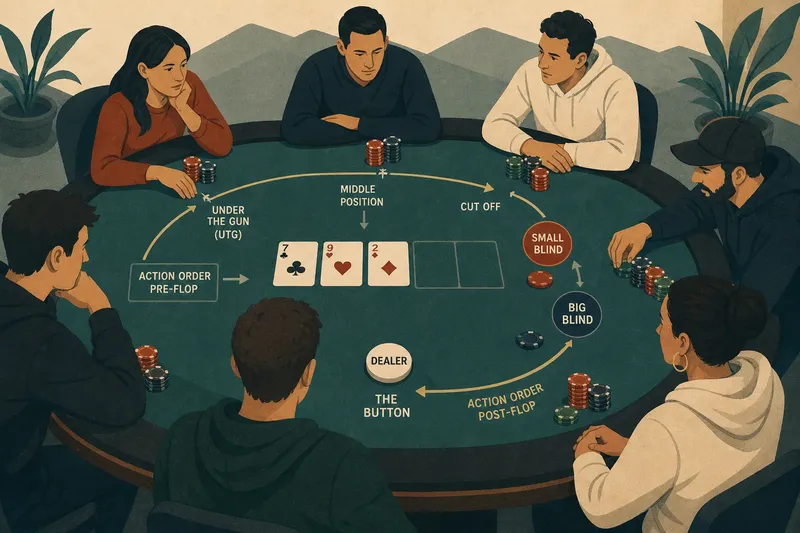
The small round disc marked “DEALER” sits in front of one player. In a home game, that person may physically deal the cards. In a casino, a dedicated dealer usually handles the deck while the disc still marks the nominal dealer for the hand.
That distinction matters because the button is not simply a job assignment. It is a reference point for the table’s positions and the sequence of action. Players use it to tell who is in the blinds, who acts first, and who has the last opportunity to act in a betting round.
After a hand ends, the button moves clockwise to the next player who remains in the game. The blind positions move with it, so the table’s order changes from hand to hand rather than staying attached to particular seats.
Watch the disc, not the person handling the deck.
2. The small blind and big blind move with the button
The two seats immediately clockwise from the button post the blinds: the small blind first, then the big blind. These are forced bets that start the pot and give the hand something to play for before anyone has chosen to call or raise.
Because the button advances, every player takes a turn in each blind position as it comes around the table. In a typical hand, the button player does not post either blind; the players just clockwise of the button do. Table rules can differ in unusual situations, such as when a player joins or leaves, so the dealer’s instructions settle the arrangement.
The blinds also affect how much a player has already put into the pot when action reaches them. A blind can fold, call the remaining amount, or raise when the action allows it. Posting a blind does not force someone to continue with a weak hand.
Being in a blind is a position, not a promise to defend the bet.
3. The first betting round starts to the left of the big blind
Once each player has received two private cards, the pre-flop betting round begins with the first player still in the hand to the left of the big blind. This seat is often called “under the gun”, or UTG, because it must act before the other players.
That player can fold, call the big blind, or raise, subject to the game’s betting rules. Action then travels clockwise. The button player acts late in this round, but not last: the small blind and big blind still have their turns if they have not folded.
The big blind has a special option if no one has raised and all players before it have called or folded. It may check, ending its pre-flop action without adding chips, or raise. If someone raises before the action reaches it, the big blind must respond to that raise rather than relying on the option to check.
Pre-flop, the blinds act late; after the flop, they act early.
4. The button usually acts last after the flop
After the first three community cards—the flop—are dealt, the first player still in the hand to the left of the button acts first. The turn and river betting rounds follow the same order. If the button is still in the hand, it normally gets the final action in each of those rounds.
Acting last is useful because a player can see what opponents do before choosing to check, bet, call, raise, or fold. That does not reveal their cards or make a hand stronger. It simply gives the button player more information about the current round’s decisions.
If the button has folded, it does not act. The remaining players continue in clockwise order from the first eligible seat to the left of the button. The position still provides a reference for the table, but only players in the hand take part in the betting.
Late action offers information, not certainty.
5. Position changes what a player knows at decision time
Position is a player’s place in the action order, and its value changes by betting round. An early-position player has fewer actions to observe before deciding. A late-position player has seen more of the table’s choices and can respond to that information.
That difference can shape sensible hand selection. From an early seat, a player may prefer to enter the pot with hands they are comfortable playing against several opponents. From a later seat, they can consider the earlier players’ folds, calls, and raises before choosing whether to join. The right choice still depends on the cards, the action, the rules, and the players involved.
Imagine a player on the button holding a modest hand. Everyone before them folds, and the blinds have yet to act. They can choose whether to enter the pot knowing the earlier seats declined, while also recognising that the blinds may still call or raise. The observable difference is the information available before the choice—not a promise that the hand will win.
Position is part of the decision; it is not a substitute for one.
6. The button’s advantage has limits
It is easy to hear that the button is the strongest seat and assume it makes every hand favourable. In reality, it does not change the cards, the size of the pot, or the choices made by opponents. A poor hand can remain poor, and a player who faces a large raise still has to decide whether continuing makes sense.
The button also does not act last before the flop in the same way it does after the flop. The blinds are still to act behind it during the opening betting round. A button player who raises should remember that either blind can respond, and a raise from a blind can send the action back around.
So think of the button as a recurring informational advantage, not a licence to play every hand. It can help a player make a more informed choice, but the choice still needs to fit the situation.
Use the button to read the action, not to excuse a reckless call.
7. The button’s movement keeps the table order fair
Moving the button clockwise ensures that the nominal dealer role and the blind positions rotate around the table. If the disc stayed with one player, that person’s relationship to the blinds and the betting order would never change, leaving everyone else with a different pattern of forced bets and positions.
At a casual table, the dealer may announce the button’s new seat before dealing. In a casino, the disc itself makes the change visible. Either way, players can check its location before putting in blinds or acting; it is a simple habit that prevents confusion when seats are added, removed, or missed during a busy game.
If you are unsure where action begins, ask the dealer before committing chips.
How does the dealer button affect play?
Does the player on the button deal the cards?
Not necessarily. In a home game, the button player may deal, while a casino dealer usually handles the cards. The disc marks the nominal dealer and determines table positions either way.
Who acts first before the flop?
The first active player to the left of the big blind acts first. This is commonly called the under-the-gun position, and action then proceeds clockwise.
Who acts first after the flop?
The first active player to the left of the button acts first on the flop, turn, and river. If that seat has folded, the next player still in the hand acts.
Does the button always act last?
The button usually acts last in post-flop betting rounds if its player remains in the hand. Before the flop, the blinds act after the button, so it is not the final player to make a decision in that round.
8. A quick button check prevents avoidable confusion
Before the next hand, look for the disc and trace the order aloud if needed: button, small blind, big blind, then the first player to act before the flop. After the flop, start with the first active player to the button’s left. That small check is especially helpful at a home game where the dealer may change hands.
Remember the main point about the dealer button in Texas Hold’em: it marks the nominal dealer, moves the blinds around the table, and anchors the order of action. Once you can locate it, you can tell when your turn is coming and what other players have already chosen to do.
Keep the disc in view, and let the action order guide your next decision.