Roulette Bets by Shape: Inside, Outside, and What They Mean
Roulette bets by shape are easier to understand when you compare grid positions with labelled groups and see exactly which results each wager covers.
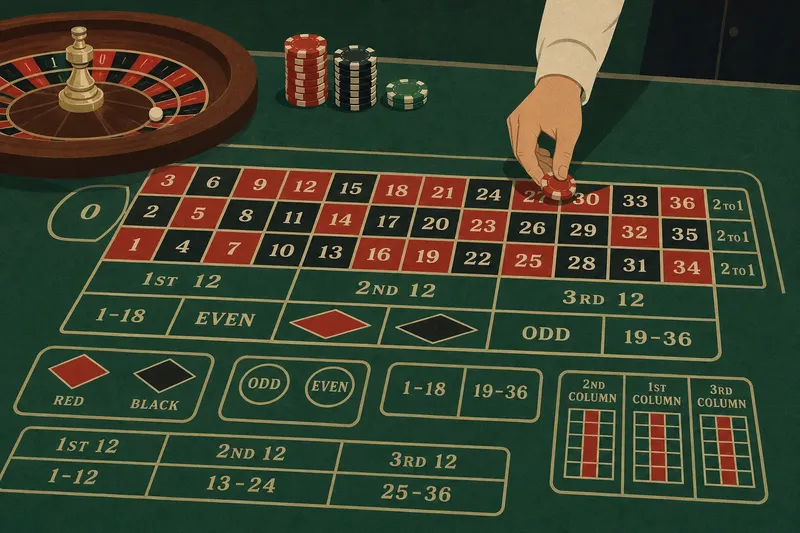
The most common mistake with roulette bets by shape is to treat the chip’s location as a decorative detail. It costs clarity: a player may know a bet’s name but still be unsure which result would count. The layout’s geometry tells a more useful story: inside bets select compact areas of the number grid, while outside bets sort numbers into named groups.
The layout gives numbers two different kinds of grouping
A standard roulette layout pairs a numbered grid with marked betting areas. An American wheel has numbers from 1 to 36 plus 0 and 00; a European wheel has numbers from 1 to 36 plus a single 0. The layout organises these pockets into betting groups, while the wheel determines where the ball may settle.
The grid has three vertical columns and twelve horizontal rows, with three numbers in each row. Around it, printed areas identify groups such as colours, odd and even numbers, and ranges. Green zero spaces sit outside the ordinary numbered groups, so a colour, parity, range, dozen, or column bet does not normally include them.
Use the printed wording to identify a group, rather than assuming that nearby spaces share the same meaning.
Inside bets select compact areas of the grid
Inside bets refer to one numbered space or a small cluster of adjoining spaces. Their names describe how those spaces meet on the grid:
- Straight-up: one number, with the chip centred in that space.
- Split: either of two neighbouring numbers, with the chip on their shared border.
- Street: the three numbers in one horizontal row, selected from its end.
- Corner: four numbers whose spaces meet at a common point.
- Six line: the six numbers in two neighbouring rows, selected along their shared boundary.
These shapes describe which numbered spaces belong to the wager, not whether it is a better choice. The table’s displayed rules set the payout. The practical distinction is simply the set of results that would match.
Say a new player wants to select the row containing 7, 8, and 9. They choose the street position at the end of that row; the resulting wager refers to those three spaces. If the ball settles on one of them, the result matches the selected area.
Outside bets sort numbers into named groups
Outside bets use labelled areas beyond the numbered grid. Rather than selecting a small patch of adjacent spaces, they select a category:
- Red or black: one of the colours assigned to numbered pockets.
- Odd or even: one parity group among the numbered spaces.
- Low or high: the lower or upper range, commonly marked 1–18 and 19–36.
- Dozen: one of three consecutive groups, commonly 1–12, 13–24, and 25–36.
- Column: one vertical track of numbers shown beside the grid.
A dozen and a column each group twelve numbered spaces on a standard layout, but they do not select the same numbers. A dozen follows a consecutive range; a column follows the grid’s vertical arrangement. On a double-zero layout, both 0 and 00 remain separate green pockets rather than members of those ordinary groups.
Read the category name as a definition of the selected set, not as a description of the chip’s appearance.
Which roulette bet shapes cover which results?
What does a straight-up bet cover?
It covers the single numbered space beneath the chip. This is the smallest inside-bet area and names one specific number.
How does a split differ from a corner?
A split covers two neighbouring spaces that share a border. A corner covers four spaces that meet at one point.
How are a dozen and a column different?
A dozen selects a consecutive block of twelve numbers, while a column selects twelve numbers aligned in one vertical track. Both are outside bets, but their number sets differ.
Do zero and double zero belong to outside bets?
They are separate green pockets, not part of the usual colour, parity, range, dozen, or column groups. Check the table’s printed rules for any specific treatment of those pockets.
Translate the printed labels into a clear result
Imagine a player choosing between the second dozen and the second column on a European layout. They read the dozen label as 13 through 24, then trace the second column down the grid and note its listed numbers. The result is a clear comparison: one option selects a consecutive range, the other a vertical track, and neither includes 0. They can now describe what would count for either wager without relying on the position of a chip.
This way of reading the table also distinguishes the two families. An inside bet selects spaces through their adjacency on the grid: a single space, shared edge, row, or junction. An outside bet selects a group through its printed category. Both refer to pocket identities, not to a visual pattern on the spinning wheel.
If a label is unclear, pause and ask the dealer to explain the table’s wording before placing a wager.
Use the shape to understand, not rank, a bet
Inside and outside describe layout categories; they do not recommend a wager. An inside shape marks a compact part of the number grid, while an outside label groups numbers by a shared feature. The shape alone does not say which choice is preferable.
Roulette bets by shape become easier to understand when you translate each position into the result it names. Identify whether the wager selects adjacent grid spaces or a printed category, then account for any green pockets that sit outside that group. That small distinction is useful wherever the table’s terminology feels unfamiliar.